




After rising nearly 250% between October 2022 and January of this year, sentiment towards gold has shifted markedly. The metal was down 14% in Q2, its worst quarter since Q2 2013. Having traded over $5,500/oz in January it’s now close to $4,000/oz, almost a 30% decline from the highs.
Back in January all the talk was of the debasement trade, central bank buying of gold and growing retail demand. Many investors bought into gold on the view that it’s a store of a value, an inflation hedge and an asset that could be a diversifier for not only equities and bonds but fiat currencies as well.
Since then, gold has fallen out of favour. What’s more the US dollar is rising and with the new Fed Chair recommitting to price stability, suddenly the debasement idea has evaporated.
For investors, the question is: is it a temporary correction or the beginning of a larger reversal?
A blow-off top
With the benefit of hindsight, it is easy to say sentiment towards precious metals got to an extreme in January. Not only had gold posted strong gains, but silver rose by nearly 250% between August and January, clearly an unsustainable move.
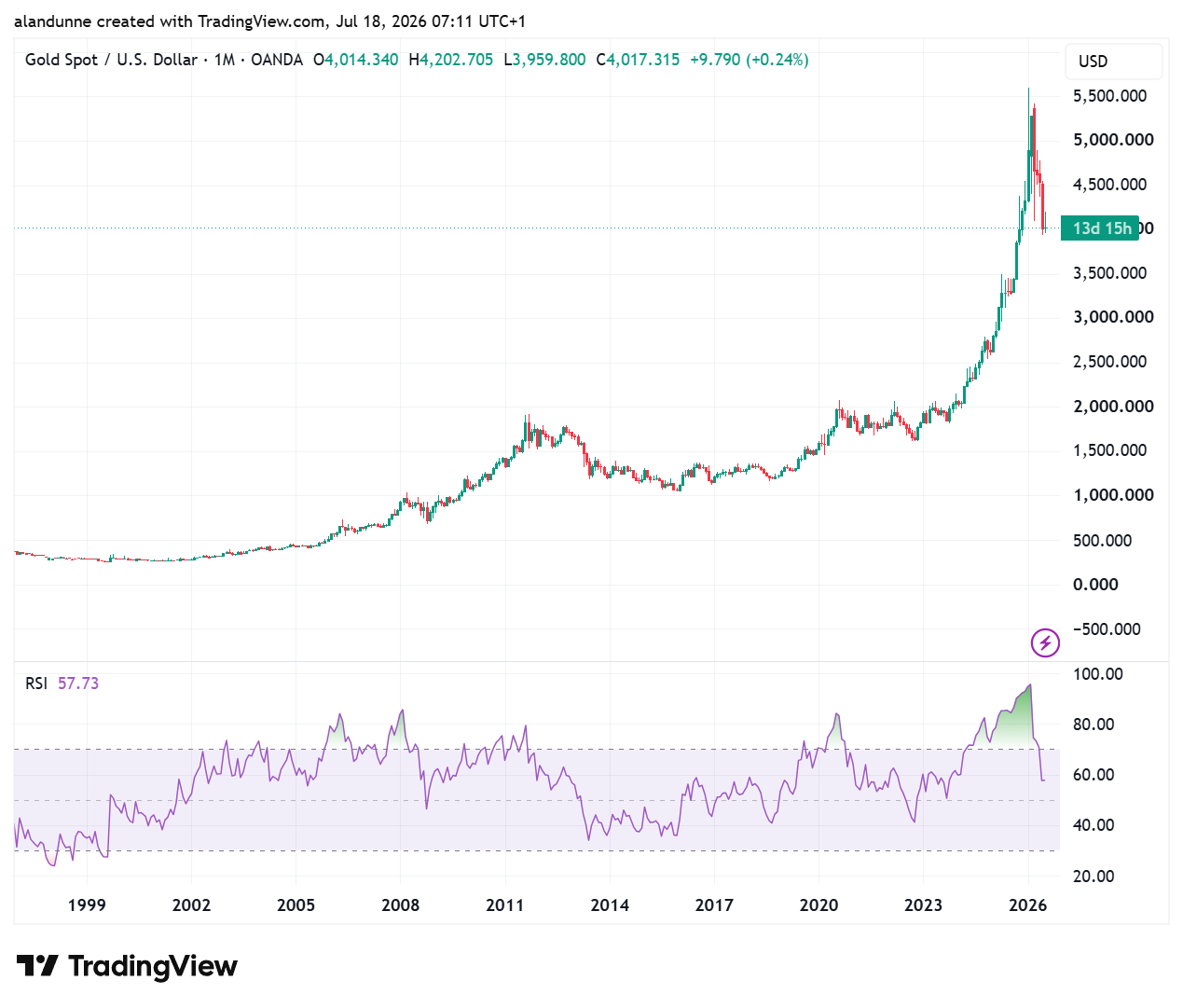
But the warnings had been in place for gold too. Technical indicators like the 14-month RSI touched 95 in February, an extreme overbought condition and as of the end of January gold was about 45% above its 200-day moving average, the largest deviation from trend since the 1980 high.
From that perspective, a 30% drawdown, which just represents a 41% retracement of the move from the October 2022 lows can plausibly be seen as a natural correction in a multi-year bull trend.
Indeed, in the last mega gold move in the 1970s, gold rallied 450% from its Jan 1970 lows to December 1974 and then declined by just under 50% between Dec 1974 and August 1976, before commencing a multi-year accelerated rise to January 1980.

Shifting cycles
When I wrote “Gold’s Place in an All-Weather Portfolio” in November last year I highlighted the attractions of gold: low correlation to equities and bonds, its ability to retain its value over the very long term and strong returns particularly since 2020.
I pointed out that since 2000, re-allocating 20% of an allocation from the S&P 500 TR to gold (for an 80-20 equity/gold portfolio) would have reduced the portfolio volatility from 15.2% to 12.8% and increased the realised annualised return from 8.0% to 8.8%.
But, as I said in that piece, the challenge with gold is it is an asset that can outperform equities in one macro regime yet endure twenty years of negative real returns in another.
It soared during the great inflation of the 1970s.
Then came two lost decades as inflation fell and central banks became heavy sellers.
It rallied again in the 2000s but was range-bound for much of the 2010s.
Amid the bullish sentiment of January of this year, when investors were focused on the returns and the positive narrative, few were highlighting the fact that between 1980 and 2000 spot gold prices fell 71% in nominal terms.

The problem with gold
Arguably, the issue with gold is less about how it behaves and more about how it is perceived.
Labels like safe haven asset and store of value give an impression of safety and stability. Yet the reality is gold is more volatile than most equity indices.
Over the long term its annualised volatility is about 17% but at times its 20-day volatility can get up to 30-40%, or even close to 60%, as it did earlier this year.
Gold: 20-day annualised volatility versus long-term annualised volatility
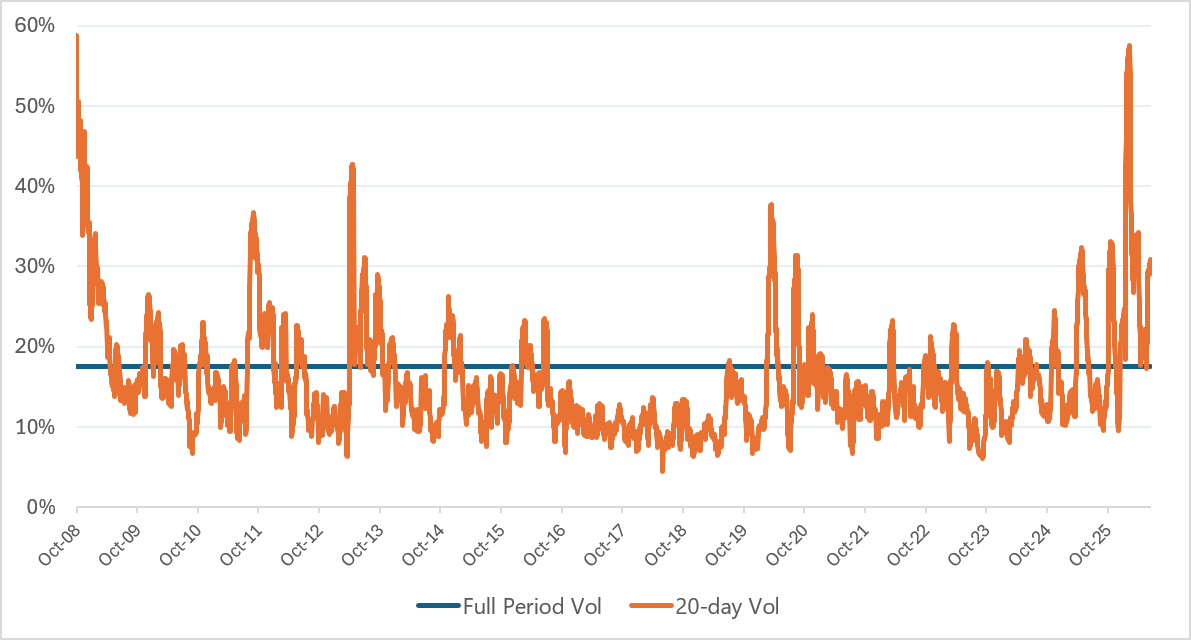
A decline of 12% in a month or 14% in a quarter is not unusual, statistically, for an asset with that type of volatility.
Over the very long-term gold has retained its purchasing power and been a hedge against inflation, but it has gone through large up and down cycles.
For investors it creates a real dilemma. Gold’s low correlation to equities and bonds encourages a meaningful allocation to the asset, but a 30% drop is painful.
In theory diversification is the only free lunch in investing but at times it can certainly feel uncomfortable.

What changed
It’s important to put the current moves in context. Even after the current drawdown, gold’s realised returns are strong. Since 2000, spot gold has risen at an annualized rate of 7.9% and since Jan 2020 spot gold prices have risen by 16.1% per annum.
And from a fundamental perspective some of the factors which have been supportive gold in the last few years have paused or even reversed of late.
Central bank buying for reserve management, due to concerns about the US dollar, has been one of the big fundamental supports. Global central banks bought about 1,000 tonnes of gold p.a. between 2022-2025 up from an average of about 470 tonnes p.a. between 2010-2021. But this year some central banks, such as the Central Bank of the Republic of Turkey, have turned sellers as they have needed to monetise profits due to budgetary pressures.
Momentum trades like CTAs would have been buying once the rally started in late 2022 and 2023. They would likely have been trimming longs late in the rally in 2025 and early 2026 as volatility increased. Once the price trend reversed CTAs would have exited remaining longs and started to turn short.
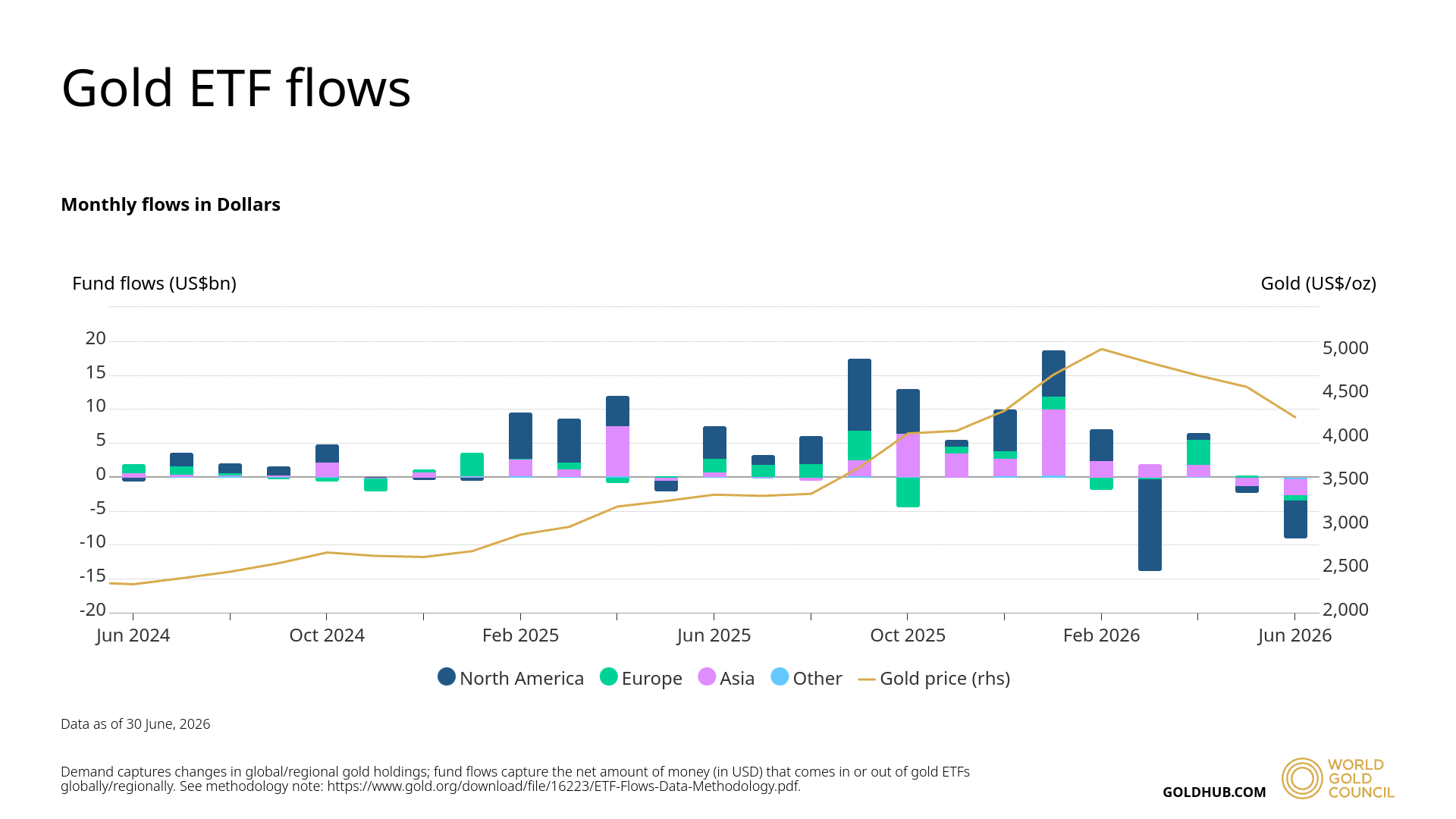
The large rise in gold also brought the metal increasingly to the attention of retail investors; ETF demand picked up notably last year and into early this year. But there is nothing like price to influence sentiment and as soon as prices stopped rising, and showed signs of reversing, ETF demand slowed and ultimately reversed.
That partially reflected a changed macro back drop. A weaker US dollar and a perception of low US interest rates were other supports, and those two factors have turned from tailwinds to headwinds.
Putting it together paints a picture of a market with real fundamental demand, on the theme of central bank reserve diversification, but with price subject to large cyclical variations based on momentum and the behaviour of retail participation.
The big picture: correction or regime change?
For all of those negatives the big picture still looks positive.
Yes, the US dollar is enjoying a cyclical rally, which could extend if the economy stays strong, inflation stays elevated and the Fed is forced to raise rates. But in the bigger picture the risks appear to be greater for dollar weakness as global investors remain overweight dollars.
Although concerns about US dollar debasement have eased for now, the US debt/GDP ratio is above 100% and that is before the looming wave of increased spending in relation to entitlements in the next few decades is factored in. Politically, there is no appetite to address the fiscal deficit, suggesting the default will be more spending and potentially more money printing over time.
Meanwhile, economic growth has been solid in the US, but the economy has become increasingly unbalanced and reliant on the AI boom. But if the AI capex cycle runs its course, at some point equities could fall and the wealth effect from rising stock prices would go into reverse. In that scenario we’d likely see even higher fiscal deficits and lower interest rates – both positive for gold.
Managing gold exposure
Is it a temporary correction or a fundamental change in trend?
History suggests the former is more likely. Gold’s boom-bust pattern has repeated for years, and a 30% drawdown after a 250% rally is well within that pattern, not outside it. In fact, another 20-25% decline from here wouldn’t be unusual either, and wouldn’t necessarily change the longer-term case.
In my original piece I highlighted the merit of a dual approach to hold exposure – maintaining a strategic long exposure to gold and combining that with active tactical exposure which can be achieved by allocating to trend following.
The tactical element would have added to overall exposure during the bull run but would have been incrementally reduced this year and is now providing a small offset to the core strategic long.
Gold is sold to investors on its label: safe haven, store of value, inflation hedge. But it should be sized and managed on its behaviour: a genuinely volatile asset that can swing 30% in a matter of months.
Investors who understand that distinction can hold gold through periods like this one. Those who don’t tend to chase it at the top and sell out in the drawdown.
Suppressors, manipulators and traders in the precious metals. Harder to have a system of ubiquitous “ price discovery” when physical supply and demand takes a back seat to paper hypothication!
Surprising little mention is made of Western governments, large commercial banks and Central Bank, as well as buillon banks and the Comex were not mentioned as potential